

Reviewed by Ashish Shah, Managing Director7 October 20266 min readSource: Large & Mega GR dated 08.09.2026
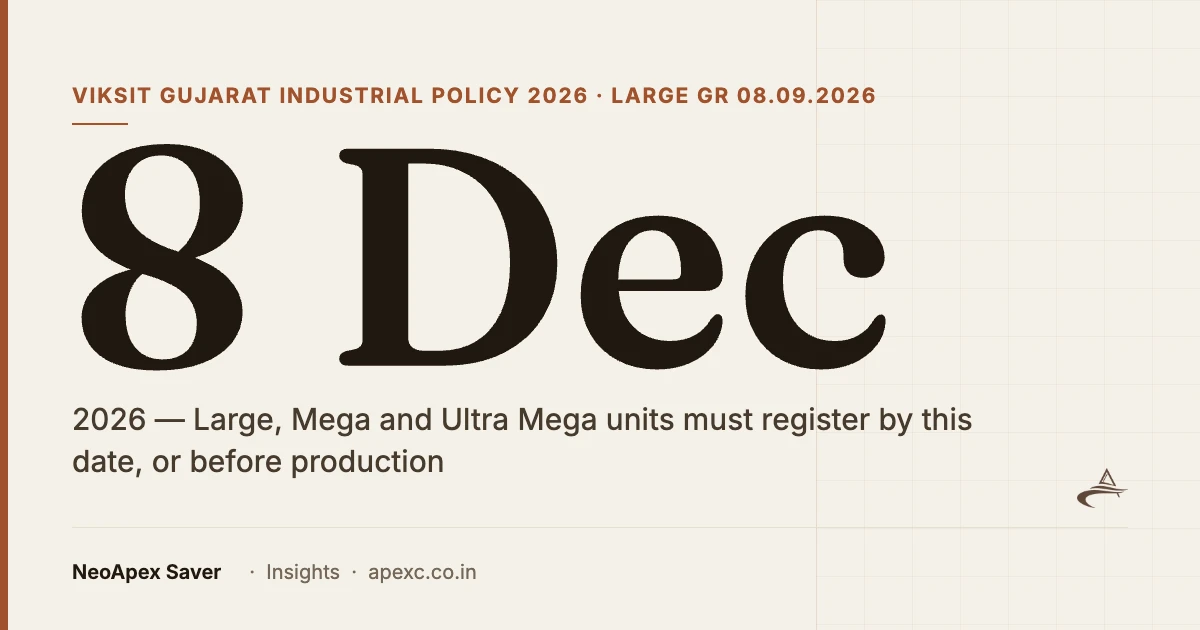
Under the VGIP 2026 scheme for Large, Mega and Ultra Mega industries, registration with the Industries Commissionerate is mandatory and must be applied for before commercial production starts or by 8 December 2026 — three months from the GR of 8 September 2026 — whichever is later. A late application is not eligible, and without registration there is no Provisional or Final Eligibility Certificate and no subsidy. Units that began production between 1 June and 8 September 2026 are the ones with the clock running.
Every unit above ₹125 crore of plant and machinery
The Large GR covers industrial undertakings whose gross fixed capital investment in plant and machinery exceeds ₹125 crore — the new MSME ceiling — together with Mega units (₹1,000 crore and 250 direct jobs in a thrust sector) and Ultra Mega units (₹10,000 crore and 3,000 jobs). Projects above ₹1,000 crore that miss the employment test, or sit outside the thrust sectors, are treated as Large units and must register too.
Already producing since June
Commercial production between 1 June and 8 September 2026 means the “before production” leg has passed; the three-months-from-GR leg gives you until 8 December 2026. Registration, then the PEC within three months of the registration certificate.
Producing from late 2026 onwards
Register before the first commercial sale bill. The GR calls the date of that bill the Date of Commencement of Commercial Production (DoCP), and every later window — PEC, FEC, quarterly claims — is counted from it.
Still deciding on the old scheme
A Large unit not in production before 1 June 2026 can opt for the previous scheme until 8 March 2027. Registering under VGIP 2026 and exercising that option are separate decisions — get the comparison done before either deadline. The option window, explained.
Registration, PEC, FEC and quarterly claims
Register with the Industries Commissionerate
Application in the prescribed format with: the undertaking’s registration document and IEM; land possession documents (possession letter for a GIDC plot or shed); GPCB Consent to Establish, if applicable; the detailed project report; and the term-loan sanction letter, if applicable. The Commissionerate issues a registration certificate.
Before DoCP or by 8 December 2026, whichever is later · never after 31 May 2031Start commercial production inside the policy period
A registered project must commence commercial production between 1 June 2026 and 31 May 2031. Investment counts from 1 January 2026 and may continue for 18 months after DoCP (projects up to ₹1,000 crore), 24 months (up to ₹10,000 crore), 36 months (up to ₹1,00,000 crore) or 48 months beyond that.
DoCP = date of the first commercial sale billApply for the Provisional Eligibility Certificate
Within three months of DoCP, of the registration certificate or of the GR, whichever is later. The PEC is issued for capital, interest and power tariff subsidy and EPF reimbursement on the basis of Chartered Accountant and Chartered Engineer certificates of the investment completed by DoCP, up to 40% of EFCI. If the investment is complete at DoCP, apply directly for the FEC in the same window.
3 months · PEC covers up to 40% of EFCIApply for the Final Eligibility Certificate
Within three months of completing the project, or within three months of the end of the eligible investment period if the project is not complete by then. Filed between three months and one year late, the incentive period and amount are cut in proportion to the delay; beyond one year, the application is not entertained.
3 months · outer limit 1 yearClaim every quarter
After the eligibility certificate, claims for assistance are submitted at three-month intervals in the prescribed format. Interest subsidy is paid on interest actually charged on the disbursed term loan; power tariff subsidy on bills in the undertaking’s name; capital subsidy in equal annual instalments over the incentive period.
Quarterly, through the 8–12 year incentive period
Conditions that travel with the registration. At least 85% of all employees and 60% of managerial and supervisory staff domiciled in Gujarat; a GPCB certificate where applicable; continuous production through the incentive period unless a stoppage beyond the unit’s control is condoned; state plus central incentives never exceeding EFCI. Breach makes the disbursed subsidy recoverable with 18% interest a year.
The registration is the gate to every rupee
The Large GR’s structure is linear: no registration, no PEC; no PEC or FEC, no claim. Para 8.3 removes any discretion — an application for registration after the prescribed time limit is simply not eligible. That is different from the FEC, where a late filing is cut in proportion rather than refused outright. For a ₹300 crore project in a Category B general-sector taluka the combined ceiling is 15% of EFCI, or ₹45 crore over ten years; in a thrust sector in Category A it is 35%, or ₹105 crore. A missed three-month window is an expensive calendar error.
What we do for Large clients in the first quarter after the GR: confirm unit class and sector tier (thrust, selected thrust or general) against Annexure-A, confirm the taluka category from the 2026 list, assemble the registration file, and diary the PEC and FEC windows from the actual DoCP. The full Large, Mega and Ultra Mega tables are in our policy guide.
Large-unit registration: frequently asked questions
Who has to register with the Industries Commissionerate?
Every Large, Mega and Ultra Mega industrial undertaking that wants incentives under the VGIP 2026 Large GR (No. IMD/WRT/e-file/9/2026/2320/I dated 8 September 2026). Para 8.1 makes registration mandatory; para 8.3 says an application after the time limit is not eligible. MSMEs claim under a separate GR and do not register this way.
What exactly is the deadline?
Before the date of commencement of commercial production, or within three months of the GR — 8 December 2026 — whichever is later, and in any case before 31 May 2031. A unit that started production between 1 June and 8 September 2026 therefore has until 8 December 2026; a unit starting production in 2027 must register before its first commercial sale.
What documents go with the registration application?
The undertaking’s registration document and Industrial Entrepreneur Memorandum, documents of legal possession of land (the possession letter for a GIDC plot or shed), GPCB Consent to Establish where applicable, the detailed project report and the term-loan sanction letter if there is a loan.
When is the PEC due after registration?
Within three months of the date of commercial production, the date of the registration certificate or the date of the GR, whichever is later. The Provisional Eligibility Certificate is issued for up to 40% of eligible fixed capital investment; the Final Eligibility Certificate follows within three months of completing the investment.
What if the FEC is filed late?
Between three months and one year late, the incentive period and amount are reduced in proportion to the delay. Beyond one year from the end of the eligible investment period, no FEC application is entertained.
Producing since June? Register before 8 December 2026
Send us your IEM, land papers and project report. We confirm your class, sector tier and taluka category, file the registration and diary every window that follows.

Written by the NeoApex Saver advisory team · Reviewed by Ashish Shah, Founder & Managing DirectorNeoApex Saver Pvt Ltd (formerly Apex Consultants) has filed Gujarat industrial incentive claims for over twenty years — 300+ projects, 99% filing success. Every figure in this article is taken from the Government Resolution linked above; worked examples and the reading of grey areas are ours.Last reviewed 7 October 2026 · About the team · Report a correction