

Reviewed by Ashish Shah, Managing Director7 October 20266 min readSource: Gujarat Electricity Duty Act, 1958 · CEICED e-services
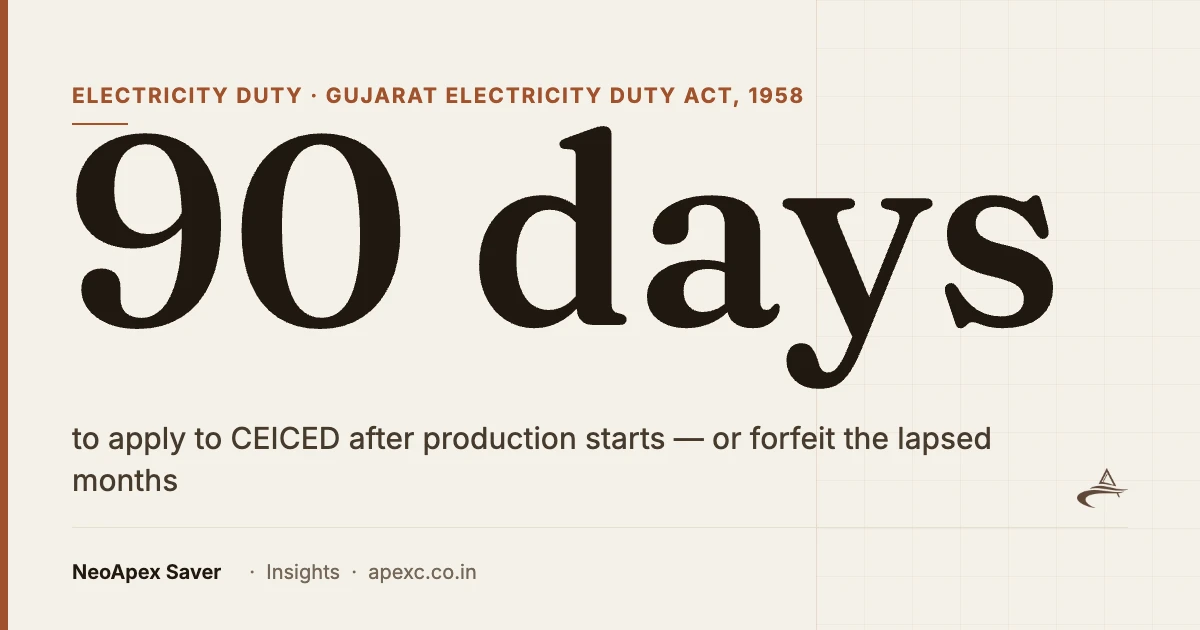
A new industrial undertaking in Gujarat pays no electricity duty for five years from the day it first manufactures or produces goods — Section 3(2)(vii) of the Gujarat Electricity Duty Act, 1958. The exemption is not automatic: the unit must apply to CEICED for a certificate of eligibility within 90 days of the date of production. File late and the window does not move. Under Rule 11(3) of the Bombay Electricity Duty (Gujarat) Rules, 1986, the months that have already passed are forfeited unless the State condones a delay that was beyond your control. On a ₹15 lakh monthly HT bill, each lost month is ₹2.25 lakh that will never come back.
Two dates, and only one of them moves
The Act fixes the exemption period by the production date: five years “from the date on which such industrial undertaking begins to manufacture or produce goods for the first time”. The proviso to the same clause says no undertaking is entitled to the exemption unless it has obtained the certificate of eligibility by applying “within such period … as may be prescribed” — and the prescribed period is 90 days. Put together:
The production date
Set by what happens on your shop floor — the first day goods are manufactured or produced. Not the first invoice, not the first DISCOM bill, not the certificate. The five years end on the fifth anniversary of this day, whatever you do afterwards.
The application date
Within 90 days of the production date, online on CEICED e-services, with proof of investment, the connection and the production date. In time, the exemption covers the whole five years and duty billed in the meantime is claimed back from the DISCOM.
A late application
The exemption is available only for what is left of the window. The lapsed months are forfeited under Rule 11(3) unless the State condones the delay — and even then the window still ends on the original date.
Why the date is not the first bill. Many units wait for the first DISCOM bill, or for the connection to be “regularised”, before they think about the exemption. By then a month or two of the 90 days has gone. Note the first production day in the production register on the day itself, and start the file that week.
Each lapsed month, on three typical bills
Electricity duty on an HT connection is 15% of consumption charges (10% on an LT connection), so the cost of delay is simple arithmetic: monthly duty × months lapsed. Three Gujarat units, round numbers:
Swipe sideways to see every column
| Unit | Duty each month | 3 months lapsed | 6 months lapsed | 12 months lapsed | 24 months lapsed | Full 5-year exemption |
|---|---|---|---|---|---|---|
| Small engineering unit, Rajkot₹5 lakh a month on HT | ₹0.75 lakh | ₹2.25 lakh | ₹4.5 lakh | ₹9 lakh | ₹18 lakh | ₹45 lakh |
| Auto-component plant, Sanand₹15 lakh a month on HT | ₹2.25 lakh | ₹6.75 lakh | ₹13.5 lakh | ₹27 lakh | ₹54 lakh | ₹1.35 crore |
| Ceramic tile plant, Morbi₹40 lakh a month on HT | ₹6 lakh | ₹18 lakh | ₹36 lakh | ₹72 lakh | ₹1.44 crore | ₹3.6 crore |
Captive generation is extra: power from a DG set above 125 kVA, or a captive plant, carries duty of 60 paise a unit and is covered by the same application. A unit in a Special Economic Zone has a ten-year window for a new unit, so the same arithmetic runs for 120 months.
In power-intensive clusters — kiln lines in Morbi, chemical units in Ankleshwar and Dahej, foundries in Rajkot, engineering shops in Halol and Savli — the duty line is the single largest tax a new plant can switch off, and it is the one most often lost to the calendar.
Seven ways units file late
- Waiting for the first bill. The clock starts on the production day; the first bill arrives weeks later and the 90 days are already running.
- Assuming a GIDC unit is covered automatically. It is not. Every unit needs its own certificate, in every estate.
- Connection in the wrong name. A connection still in the contractor’s, the landlord’s or the previous occupant’s name delays the application. Take the HT or LT connection in the unit’s own name before production.
- Treating trial production as “not production”. The Act speaks of the day the unit begins to manufacture or produce goods for the first time. If saleable goods came off the line in the trial run, that day counts. Record it, and apply from it.
- Leaving the DG set out. Adding a generating set later earns only the remaining part of the period. Include it in the first application.
- Expansion on the same meter. An additional unit must be separately metered. Without a sub-meter the exempt consumption cannot be measured, and the application stalls.
- Filing with gaps. Invoices that do not show machinery is new, a missing consent, mismatched dates between the connection papers and the production record — each query adds weeks, and the window does not pause for queries.
What to do this week, in order
Fix the production date from the records
Pull the production register, the first batch or heat record and the first sale invoice. The Act’s date is the first day of manufacture, which may be earlier than the first sale. Use the date the records support — not a convenient one.
Day 1File on CEICED e-services now
Every further month is another month of duty forfeited. File with what you have — proof of investment in new plant and machinery, the connection in the unit’s name, the production evidence — and supply the rest on query rather than waiting to perfect the file.
This weekAttach a condonation request only if the delay was beyond your control
Set out the cause and the evidence: a DISCOM delay in releasing the connection, a calamity, a court or regulatory order. Condonation is a discretion of the State; the request should read like a record, not an appeal.
With the applicationPut the DG set and any additional unit in the same file
A generating set above 125 kVA is registered with the Collector of Electricity Duty and its units are exempt for the same period if it is in the application. An expansion needs its own meter reading from the day it starts.
Same applicationSend the certificate to the DISCOM and claim the refund
Once the certificate issues, give it to UGVCL, DGVCL, MGVCL, PGVCL or Torrent Power. Bills from the next cycle should carry a zero duty line; duty billed for the covered period is refunded or adjusted. Check every bill until it is.
On issueDiary the end date
The exemption ends on the fifth anniversary of production (the tenth for a new SEZ unit). Furnace-based units should line up the lower 10% duty rate for the day duty resumes.
Year 5
If you are inside the 90 days, nothing is lost yet. Duty charged between the production date and the certificate is recoverable. The application does not have to be perfect on day one; it has to be in time.
Late applications: the questions we are asked
What is the time limit to apply for electricity duty exemption in Gujarat?
Apply to CEICED — the Chief Electrical Inspector and Collector of Electricity Duty — within 90 days of the date on which the unit first manufactures or produces goods. The five-year exemption under Section 3(2)(vii) of the Gujarat Electricity Duty Act, 1958 runs from that production date whether or not you have applied.
If I apply late, does the five-year exemption period get extended?
No. The five years are counted from the date of first production, not from the application or the certificate. Under Rule 11(3) of the Bombay Electricity Duty (Gujarat) Rules, 1986 a late application forfeits the exemption for the period that has already lapsed; the end date of the window does not move.
Can a late application be condoned?
The State can condone a delay that was beyond the unit’s control, but it is a discretion, not a right. File immediately, and attach a reasoned condonation request with evidence — a DISCOM delay in releasing the connection, a natural calamity, a change of constitution — rather than an apology. Do not count on condonation when you plan the project.
From which date does the exemption start — production, first bill or certificate?
From the date the unit begins to manufacture or produce goods for the first time, provided the application is in time. The certificate confirms that date; the DISCOM then stops charging duty from the next bill and the duty already billed for the exempt period can be claimed back.
Is the exemption automatic for a new unit in a GIDC estate?
No. Every eligible unit — in a GIDC estate, a private industrial park or on a standalone plot — must apply and obtain the certificate of eligibility. UGVCL, DGVCL, MGVCL, PGVCL and Torrent Power keep charging duty until the certificate reaches them.
Can I recover electricity duty already paid on bills after the production date?
Yes, for the period the certificate covers. Once CEICED issues the certificate, send it to the DISCOM: later bills carry no duty, and the duty paid on bills from the effective date of the exemption is refunded or adjusted. Duty paid for months that lapsed through a late application is not recoverable unless the delay is condoned.
Do expansions and additional units have the same 90 days?
Yes. An additional unit of an existing undertaking outside an SEZ is exempt for five years under Section 3(2)(viii), on its own separately metered consumption, and needs its own certificate applied for within the same 90 days of the date the new unit starts production.
Started production and not yet applied?
Send us the production date, the connection details and the DISCOM. We check the eligibility, file on CEICED and follow the certificate through to a zero duty line on your bill — and tell you plainly if months have already lapsed.

Written by the NeoApex Saver advisory team · Reviewed by Ashish Shah, Founder & Managing DirectorNeoApex Saver Pvt Ltd (formerly Apex Consultants) has filed Gujarat industrial incentive claims for over twenty years — 300+ projects, 99% filing success. Every figure in this article is taken from the Government Resolution linked above; worked examples and the reading of grey areas are ours.Last reviewed 7 October 2026 · About the team · Report a correction