

Reviewed by Ashish Shah, Managing Director7 October 20267 min readSource: MOOWR scheme guide · EPCG scheme guide
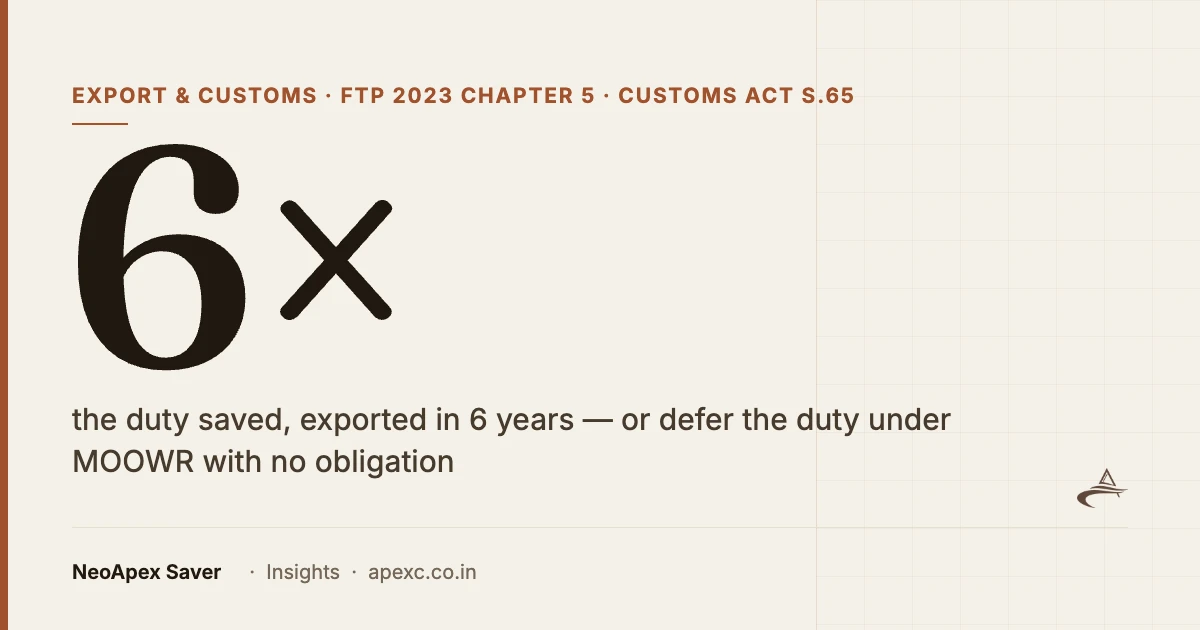
EPCG (Foreign Trade Policy 2023, Chapter 5) lets you import capital goods at zero customs duty — and without IGST or cess for physical exports — in return for exporting six times the duty saved within six years, over and above your average exports. MOOWR (Section 65, Customs Act 1962) does not waive the duty: it defers it, without interest or time limit, for as long as the machine works inside your bonded factory — with no export obligation, nothing to pay on exported output, and the same treatment for imported raw materials. On a ₹10 crore machine at the usual rates the duty is about ₹2.77 crore: EPCG makes it disappear against ₹16.64 crore of extra exports; MOOWR keeps it out of the port bill for as long as you like. Four questions decide which one fits.
The same machine, two routes
Swipe sideways to see every column
| EPCG | MOOWR | |
|---|---|---|
| Legal basis | Foreign Trade Policy 2023, Chapter 5; Handbook of Procedures 2023, Chapter 5 | Section 65 of the Customs Act, 1962, with a Section 58 private warehouse licence; MOOWR (No. 2) Regulations, 2019 |
| Duty on the machine | Waivedcustoms duty, and IGST and cess for physical exports | Deferredfor as long as the machine stays in bond — no interest, no time limit |
| Export obligation | 6× the duty saved in 6 yearsat least half by the end of year 4, above your 3-year average | Noneduty on exported content is never paid |
| Imported raw materials | Not covered (Advance Authorisation is the FTP route for inputs) | Covered: duty paid only on the imported content of goods sold in India, at clearance |
| Selling in India | Allowed, over and above the export obligation | Allowed — ex-bond bill of entry, duty on imported content, GST on the sale |
| Selling or moving the machine | Actual-user condition until the EODC is issued | Clear it out of bond on payment of the deferred duty |
| Time limits | Import within 24 months; installation certificate within 6 months of completing imports | No time limit on goods in bond; goods must reach the warehouse and be acknowledged within a month of removal from the port |
| If things go wrong | Unmet obligation: duties saved in proportion, with interest | Nothing to recover — duty simply becomes payable when goods are cleared for home consumption |
| Administered by | DGFT regional authority (Ahmedabad, Rajkot, Surat, Vadodara) | Customs commissionerate (Ahmedabad, Kandla, Mundra, by jurisdiction) |
| Running compliance | Block-wise export tracking, average-export maintenance, redemption (EODC) | Digital stock records, monthly return within 10 days of month-end, triple-duty bond, warehouse keeper |
| Best for | Established exporters buying machinery for an export line | Regular importers of machinery or inputs, domestic or export |
Duty figures in this article use 7.5% basic customs duty, the 10% social welfare surcharge on it and 18% IGST — an effective 27.7% of the assessable value. Your tariff lines may differ; anti-dumping duty, where it applies, is extra.
Four questions, in order
Can you export six times the duty saved — on top of what you export already?
Work the obligation out before anything else. ₹10 crore of machinery saves about ₹2.77 crore of duty and IGST, so the specific export obligation is about ₹16.64 crore, at least ₹8.32 crore of it by the end of year four. All of it must come above your average exports of the three preceding licensing years for the same and similar products. If the honest answer is “probably”, that is a no.
EPCG only if the order book clears 6× comfortablyHow certain is that export plan?
Under EPCG a shortfall means paying back the duties saved in proportion, with interest, after at most two one-year extensions on a 2% composition fee. Under MOOWR there is no shortfall to measure: if exports fall, you pay duty on what you sell in India, at clearance, and nothing more. Units whose export share swings year to year — many engineering exporters in Rajkot and Jamnagar, chemical units in Ankleshwar — are usually better placed under MOOWR.
Uncertain exports → MOOWRDo you also import inputs?
EPCG is for capital goods only. MOOWR covers the raw materials and components that arrive every month as well: duty on the imported content of exported goods is never paid, and duty on domestic sales is paid only at clearance, without interest. For a unit near Mundra, Kandla or Hazira importing both a line and its feedstock, one MOOWR licence does both jobs; an exporter importing inputs only may compare Advance Authorisation instead.
Machine + inputs → MOOWRWhat will happen to the machine later?
Under EPCG the machine stays with you at the declared premises until the Export Obligation Discharge Certificate; after that it is yours free of duty. Under MOOWR the duty is only parked: clear the machine out of bond — to sell it, or move it to a sister unit outside bond — and the deferred duty falls due. For a line you will run for fifteen years that rarely matters; for a machine you may resell in three, it does.
Deferred is not forgiven
The honest maths under MOOWR. IGST paid at import would normally come back as input tax credit, and exporters recover part of their input duty through drawback or RoDTEP. The real gain is the basic customs duty on exported content, plus the financing cost of duty you no longer pay upfront — on ₹20 crore of machinery, roughly ₹5.55 crore kept in the business, worth about ₹55 lakh a year at 10%.
How the answers fall in practice
Textile processor, Surat
Imports ₹10 crore of processing machinery; exports 60% of output with contracted buyers and a rising three-year average. Duty saved ₹2.77 crore; obligation ₹16.64 crore. At ₹4 crore a year of exports above the average, the obligation is met in a little over four years and the duty is gone for good.
Auto-component supplier, Sanand
Imports ₹20 crore of machining centres and presses; 90% of sales go to Indian OEMs. Six times the duty would mean ₹33 crore of new exports — not credible. Under MOOWR the ₹5.55 crore of duty and IGST is never paid at the port; the machines run under bond indefinitely with no obligation.
Chemical unit, Dahej
A ₹15 crore line plus ₹30 crore of imported intermediates a year, 40% of output exported. One MOOWR licence covers both: about ₹4.16 crore of duty on the line deferred, and of the ₹8.32 crore of annual duty on inputs, the exported share — ₹3.33 crore a year — is never paid; ₹4.99 crore is paid at clearance on domestic sales.
Figures from our MOOWR calculator and EPCG calculator, at 7.5% basic customs duty, the 10% surcharge and 18% IGST. Machinery bought from an Indian manufacturer against an EPCG authorisation carries a 25% lower obligation (4.5×); so do exporters of green technology products.
One machine, one route — and three things to confirm first
- The same machine takes one route. A capital good is either imported duty-free under an EPCG authorisation or warehoused under bond under Section 65; it cannot be both.
- Different goods in one unit. Whether an EPCG authorisation for machinery and a MOOWR permission for inputs can run side by side at one premises depends on how your Customs commissionerate reads the regulations and the bond. We confirm it with the jurisdictional office before you commit, not after.
- IGST under MOOWR. Section 65A of the Customs Act, added by the Finance Act, 2023, would collect IGST and cess at the time goods are brought in for Section 65 operations, from a date yet to be notified. If it is notified, the cash-flow case for MOOWR on machinery narrows to basic customs duty and the surcharge.
- State incentives are unaffected. Neither route touches your Viksit Gujarat Industrial Policy 2026 package — capital, interest and power tariff subsidy, electricity duty exemption and EPF reimbursement are claimed as usual. Imported machinery counts toward eligible fixed capital investment whichever customs route it takes.
Choose EPCG, choose MOOWR, or ask
Swipe sideways to see every column
| Choose EPCG if… | Choose MOOWR if… | Ask before choosing if… |
|---|---|---|
| You already export, and six times the duty saved fits comfortably above your three-year average within six years | Most of your output is sold in India, or the export share is uncertain | You want EPCG for the line and a bond for the inputs at the same premises |
| The machine serves a product with contracted export buyers | You import raw materials or components every month as well as the machine | Your machine is on CBIC’s restricted list or carries anti-dumping duty |
| You want the duty gone rather than parked, and will keep the machine until redemption | You want no export obligation, no interest and no time limit, and can keep customs-grade digital records | You might resell or relocate the machine within a few years |
| You can file the installation certificate within six months and track exports block by block | Your plant is a greenfield or brownfield project near Mundra, Kandla, Pipavav or Hazira importing in volume | Section 65A has been notified since you last checked |
What we do before you choose. Classify the machine, fix the duty saved on actual tariff rates, stress-test the export book against the 6× obligation and the average-export condition, model the MOOWR cash flow with and without IGST deferral — and only then recommend a route.
MOOWR vs EPCG: the questions we are asked
Is MOOWR better than EPCG?
Neither is better in the abstract. EPCG removes the duty on capital goods outright but binds you to export six times the duty saved within six years, over and above your three-year average exports. MOOWR only defers the duty — without interest or time limit, for as long as the machine works under bond — but asks for no exports at all and covers imported inputs too. A unit with a firm export book usually gains more from EPCG; a unit selling mainly in India, or unsure of its exports, is safer under MOOWR.
Does MOOWR have an export obligation?
No. Under Section 65 of the Customs Act, 1962 and the MOOWR (No. 2) Regulations, 2019 there is no export obligation, no interest on the deferred duty and no time limit on how long goods stay in bond. If exports fall, the unit simply pays duty on the imported content of what it sells in India, at clearance.
Is IGST exempt under EPCG?
Yes, for capital goods imported under an EPCG authorisation for physical exports: paragraph 5.01 of the Foreign Trade Policy 2023 exempts them from IGST and compensation cess as well as customs duty — and the export obligation is six times the whole amount saved, IGST included.
Is IGST deferred under MOOWR?
Today, yes: basic customs duty, the social welfare surcharge, IGST and compensation cess are all deferred while goods remain in bond. Section 65A, inserted by the Finance Act, 2023, allows IGST and cess to be collected when goods are brought in for Section 65 operations, but only from a date the Government notifies. We confirm the position for your tariff lines before you file.
What happens if the EPCG export obligation is not met?
The period can be extended twice, by a year each, on a composition fee of 2% of the duty saved in proportion to the unfulfilled obligation. If the shortfall remains, the holder pays the duties, taxes and cess saved in proportion to it, with interest. That is why the order book is stress-tested before the authorisation is applied for.
Can I sell or move a machine imported under MOOWR or EPCG?
Under EPCG the actual-user condition applies until the Export Obligation Discharge Certificate is issued — the machine stays with the authorisation holder at the declared premises. Under MOOWR the machine can be cleared out of bond for home consumption at any time, on payment of the deferred duty; the duty was deferred, not forgiven.
Who handles MOOWR and EPCG applications for a Gujarat unit?
MOOWR applications go to the jurisdictional Principal Commissioner or Commissioner of Customs — in Gujarat typically the Ahmedabad, Kandla or Mundra commissionerate — now that Invest India’s online facility has closed (Circular 27/2025-Customs). EPCG authorisations come from the DGFT regional authorities in Ahmedabad, Rajkot, Surat and Vadodara.
Importing machinery in the next twelve months?
Send us the machine list with values and HS codes, your three-year export figures and the domestic-export split you expect. We model EPCG and MOOWR side by side and tell you which one fits — and what it would cost if the export plan slips.

Written by the NeoApex Saver advisory team · Reviewed by Ashish Shah, Founder & Managing DirectorNeoApex Saver Pvt Ltd (formerly Apex Consultants) has filed Gujarat industrial incentive claims for over twenty years — 300+ projects, 99% filing success. Every figure in this article is taken from the Government Resolution linked above; worked examples and the reading of grey areas are ours.Last reviewed 7 October 2026 · About the team · Report a correction