

Reviewed by Ashish Shah, Managing Director7 October 20267 min readSource: MSME GR dated 25.09.2026
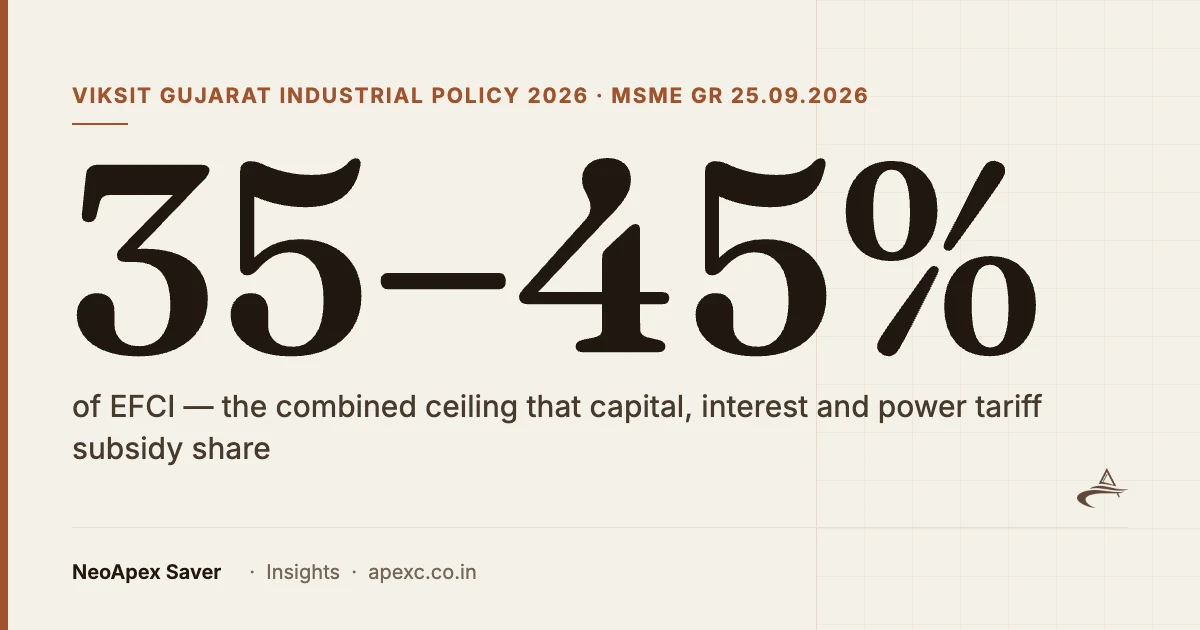
Under the VGIP 2026 MSME GR an enterprise “can choose any one component or a combination” of capital subsidy, interest subsidy and power tariff subsidy — but everything it collects over five years is capped at 45% of EFCI in a Category A taluka and 35% in Category B (50% and 45% in the five selected thrust sectors), and each year at 9% or 7% of EFCI for small and medium enterprises. Nothing lost to the annual ceiling can be carried forward. So the question is rarely “which component pays more” and almost always “which mix fills the ceiling every year”. After a full capital subsidy, exactly 10% of EFCI is left to fill — 2% a year — and whether your loan or your power bill fills it decides the last ₹1 crore on a ₹10 crore project.
Three ceilings, one package
Three limits apply at once, from paras 4.2 and 4.3 of the GR dated 25 September 2026. Each component has its own cap; the three together have a combined ceiling; and every year has an annual ceiling.
Swipe sideways to see every column
| Limit | Category A | Category B |
|---|---|---|
| Capital subsidy | 35% of EFCImicro: in year 1 · small and medium: over 5 years | 25% of EFCImicro: in year 1 · small and medium: over 5 years |
| Interest subsidy | 7% a year on the term loan5 years · up to 10% of EFCI | 7% a year on the term loan5 years · up to 10% of EFCI |
| Power tariff subsidy | ₹2 per unit5 years · up to 25% of EFCI | ₹1 per unit5 years · up to 25% of EFCI |
| Combined ceiling (all three) | 45% of EFCI | 35% of EFCI |
| Annual ceiling — small and medium | 9% of EFCI | 7% of EFCI |
| Annual ceiling — micro | 37% in year 1then 2% a year | 27% in year 1then 2% a year |
| Carry-forward of unused ceiling | Not allowed | Not allowed |
Selected thrust sectors (para 4.3): capital subsidy 35% (A) or 30% (B); interest subsidy up to 20% of EFCI; power tariff subsidy up to 20% of EFCI; combined ceiling 50% or 45%; annual ceiling 10% or 9% for small and medium (micro: 38% or 33% in year one, then 3% a year). 1% extra interest subsidy for women entrepreneurs, registered manufacturing start-ups and first-generation entrepreneurs, within the same ceilings.
After capital subsidy, 2% of EFCI a year is left to fill
For a small or medium enterprise the numbers line up neatly. In Category B, capital subsidy of 25% paid over five years is 5% of EFCI a year against an annual ceiling of 7%. In Category A, 35% over five years is 7% a year against a ceiling of 9%. Either way, 2% of EFCI a year — 10% over the period — remains for interest subsidy and power tariff subsidy together. (The GR says the capital subsidy is “disbursed over 5 years”; we assume five equal parts throughout.)
What interest subsidy can fill
7% of the outstanding term loan each year, up to 10% of EFCI in all. It supplies the full 2% of EFCI in a year only while the outstanding loan is at least about 29% of EFCI (7% × 28.6% = 2%). As the loan is repaid the subsidy shrinks, year by year.
What power tariff subsidy can fill
₹1 (Category B) or ₹2 (Category A) for every unit drawn from the DISCOM or through open access, up to 25% of EFCI in all. On ₹10 crore of EFCI, 2% is ₹20 lakh a year — 20 lakh units in Category B, 10 lakh in Category A. Captive generation does not count.
What cannot be done
A year filled short cannot be topped up later (para 4.2(e)). A year filled over is cut back to the ceiling. So the mix is planned year by year, in the application and at each annual claim — not once.
Why capital subsidy comes first. It is a fixed share of EFCI, needs one round of asset verification rather than five years of bank and DISCOM paperwork, and does not depend on how your loan or power bill behaves. Interest and power tariff subsidy are the variable part that completes the ceiling.
A ₹10 crore engineering unit in Rajkot, year by year
Small enterprise, general sector, Category B taluka. EFCI ₹10 crore; term loan ₹6 crore at 9.5% repaid ₹1 crore a year from the end of year one; 6 lakh units of DISCOM power a year. Combined ceiling ₹3.5 crore; annual ceiling ₹70 lakh; capital subsidy ₹2.5 crore taken as ₹50 lakh a year. The room left each year is ₹20 lakh, filled first from interest subsidy and then from power tariff subsidy:
Swipe sideways to see every column
| Year | Room left under ₹70 lakh | Interest subsidy available | Interest subsidy claimed | Power tariff subsidy claimed | Collected (with ₹50 lakh capital subsidy) | Ceiling unused |
|---|---|---|---|---|---|---|
| Year 1 | ₹20 lakh | ₹42 lakh | ₹20 lakh | — | ₹70 lakh | Nil |
| Year 2 | ₹20 lakh | ₹35 lakh | ₹20 lakh | — | ₹70 lakh | Nil |
| Year 3 | ₹20 lakh | ₹28 lakh | ₹20 lakh | — | ₹70 lakh | Nil |
| Year 4 | ₹20 lakh | ₹21 lakh | ₹20 lakh | — | ₹70 lakh | Nil |
| Year 5 | ₹20 lakh | ₹14 lakh | ₹14 lakh | ₹6 lakh | ₹70 lakh | Nil |
Five-year total: ₹3.5 crore of the ₹3.5 crore ceiling. In years one to four the loan alone covers the ₹20 lakh; in year five the loan has shrunk to ₹2 crore, the interest subsidy falls to ₹14 lakh, and the power tariff subsidy fills the rest. Had the unit claimed the full ₹42 lakh of interest subsidy in year one, the ₹22 lakh above the ceiling would simply have been cut — which is why the claim is planned to fit.
Who fills the ceiling, who leaves money behind
The same method on four profiles. All are small or medium enterprises in general sectors in Category B talukas, with capital subsidy taken in full.
Swipe sideways to see every column
| Unit | Room left each year after capital subsidy | Interest subsidy available, year 1 → year 5 | Power tariff subsidy available a year | Collected over 5 years | Left unclaimed |
|---|---|---|---|---|---|
| Engineering unit, RajkotSmall · Category B · ₹10 crore EFCI · ₹6 crore term loan repaid ₹1 crore a year · 6 lakh units a year | ₹20 lakh a year | ₹42 lakh → ₹14 lakh | ₹6 lakh | ₹3.5 croreof ₹3.5 crore | Nil |
| Food-processing unit, Kadi (Mehsana)Small · Category B · ₹8 crore EFCI · ₹1.5 crore loan repaid ₹25 lakh a year · 10 lakh units a year | ₹16 lakh a year | ₹10.5 lakh → ₹3.5 lakh | ₹10 lakh | ₹2.77 croreof ₹2.8 crore | ₹3.25 lakh |
| Ceramic plant, MorbiMedium · Category B · ₹40 crore EFCI · ₹20 crore loan repaid ₹2.5 crore a year · 1.5 crore units a year | ₹80 lakh a year | ₹1.4 crore → ₹70 lakh | ₹1.5 crore | ₹14 croreof ₹14 crore | Nil |
| Unit on captive solar, small loanSmall · Category B · ₹10 crore EFCI · ₹2.5 crore loan repaid ₹50 lakh a year · captive power (not eligible) | ₹20 lakh a year | ₹17.5 lakh → ₹3.5 lakh | — | ₹3.02 croreof ₹3.5 crore | ₹47.5 lakh |
- Rajkot fills the ceiling: a loan above 29% of EFCI in the early years, and enough power to cover the last year.
- Kadi comes within ₹3.25 lakh of its ₹2.8 crore ceiling: a small loan, but 10 lakh units a year of power tariff subsidy carry the later years.
- Morbi could fill its ₹80 lakh a year from the power tariff subsidy alone — 1.5 crore units at ₹1 — and treat the interest subsidy as optional paperwork.
- The captive-solar unit leaves ₹47.5 lakh of its ₹3.5 crore unclaimed: a ₹2.5 crore loan supplies less than 2% of EFCI from year one, and captive power earns no power tariff subsidy. A larger term loan, or DISCOM or open-access supply, would have filled it.
Category A changes the ceiling, not the logic. With capital subsidy at 35% (7% a year) and an annual ceiling of 9%, the same 2% of EFCI a year is left to fill — at ₹2 a unit, so half the units do it. For Large units the figures are smaller (general sectors: 20% or 15% of EFCI over ten years, 2% or 1.5% a year) but the method is identical; see the Large, Mega and Ultra Mega tables.
Six checks, in this order
Fix EFCI and the taluka category
Everything is a percentage of eligible fixed capital investment — assets acquired and paid for within the eligible investment period (12 months from DoCP, or 18 months where plant and machinery exceeds ₹50 crore; counted from 1 January 2026). Confirm the category under the 2026 taluka list before you model anything.
Ceiling = 35% or 45% of EFCITake capital subsidy in full
25% or 35% of EFCI. If you also receive a capital subsidy from a Central scheme, para 5.1(b) reduces the State amount so that total incentives never exceed EFCI.
5% or 7% of EFCI a yearTest the loan against the 29% line
Only term loans from banks, RBI-recognised financial institutions, ECB lenders and specified government lenders count — not other NBFCs — and only the amount disbursed within the investment period. The unit always bears at least 2%; penal interest and default periods are excluded.
Outstanding loan ≥ 29% of EFCI fills 2% a yearPut the power tariff subsidy in the application if the loan will not last
DISCOM or open-access renewable supply only, on bills in the enterprise’s name; for an expansion, a sub-meter for the additional consumption. It is the steady component — the same every year the plant runs at load.
2% of EFCI = 20 lakh units (B) · 10 lakh units (A) per ₹10 crorePlan each year, then claim to fit
Model the five years with your repayment schedule and load. Claim a mix that fits the annual ceiling; the GR does not say how an over-ceiling claim is trimmed, and nothing is carried forward either way.
Annual ceiling 7% or 9%Mind the certificates
Apply for the Provisional Eligibility Certificate within six months of DoCP (para 6.1); interest and power tariff claims open only after the PEC or FEC (paras 5.2, 5.3). The PEC covers 40% of EFCI at DoCP (para 6.6), so early claims run on a smaller base until the Final Eligibility Certificate.
PEC within 6 months of DoCP
Combining the three subsidies: frequently asked questions
Can I claim capital subsidy and interest subsidy together under VGIP 2026?
Yes. Para 4.2 of the MSME GR lets an enterprise choose any one component or a combination of capital subsidy, interest subsidy and power tariff subsidy, as long as each component stays within its own cap and the total stays within the combined ceiling — 45% of EFCI in a Category A taluka and 35% in Category B over five years, with annual ceilings of 9% and 7% for small and medium enterprises.
What is the combined ceiling for MSMEs under the Viksit Gujarat Industrial Policy 2026?
45% of eligible fixed capital investment in Category A talukas and 35% in Category B, over five years from the date of commercial production. In the five selected thrust sectors — sports goods, toys, footwear, robots and drones — it is 50% and 45%. Electricity duty exemption and EPF reimbursement sit outside this ceiling.
What is the annual ceiling, and can unused ceiling be carried forward?
Small and medium enterprises can receive at most 9% (Category A) or 7% (Category B) of EFCI in any year — 10% and 9% in the selected thrust sectors. Micro enterprises get 37% or 27% in year one and 2% a year afterwards (38%, 33% and 3% in the selected thrust sectors). Para 4.2(e) says carry-forward of incentives lost to the annual ceiling is not allowed, so a year filled short is money gone.
How much interest subsidy can an MSME get?
7% a year on the term loan actually disbursed for EFCI — 8% for women entrepreneurs, registered manufacturing start-ups and first-generation entrepreneurs — for five years, up to 10% of EFCI (20% in the selected thrust sectors), with the enterprise always bearing at least 2% of the interest. Penal interest, NBFC loans and default periods are excluded.
Does the power tariff subsidy apply to captive solar or a captive power plant?
No. Para 5.3 of the MSME GR covers power drawn from a DISCOM or renewable power through open access; power from the enterprise’s own captive plant is not eligible. For an expansion, only the additional consumption on a sub-meter counts.
Does a micro enterprise get the whole capital subsidy in year one?
Yes — 35% of EFCI in Category A or 25% in Category B is disbursed in year one, within a year-one ceiling of 37% or 27%. That leaves 2% of EFCI for interest and power tariff subsidy in year one, and 2% a year in years two to five.
Do electricity duty exemption and EPF reimbursement use up the ceiling?
No. Both are separate components of the policy. The five-year electricity duty exemption is a statutory exemption under the Gujarat Electricity Duty Act, and EPF reimbursement is claimed under its own para of the GR; neither counts toward the 35–45% combined ceiling.
Want the mix modelled for your unit?
Send us the project cost, taluka, term-loan sanction and repayment schedule, and your expected monthly units. We model the five years against the ceilings and tell you which components to claim in which year — before the application is filed.
Written by the NeoApex Saver advisory team · Reviewed by Ashish Shah, Founder & Managing DirectorNeoApex Saver Pvt Ltd (formerly Apex Consultants) has filed Gujarat industrial incentive claims for over twenty years — 300+ projects, 99% filing success. Every figure in this article is taken from the Government Resolution linked above; worked examples and the reading of grey areas are ours.Last reviewed 7 October 2026 · About the team · Report a correction