

Reviewed by Ashish Shah, Managing Director7 October 20267 min readSource: MSME GR dated 25.09.2026 · Large & Mega GR dated 08.09.2026
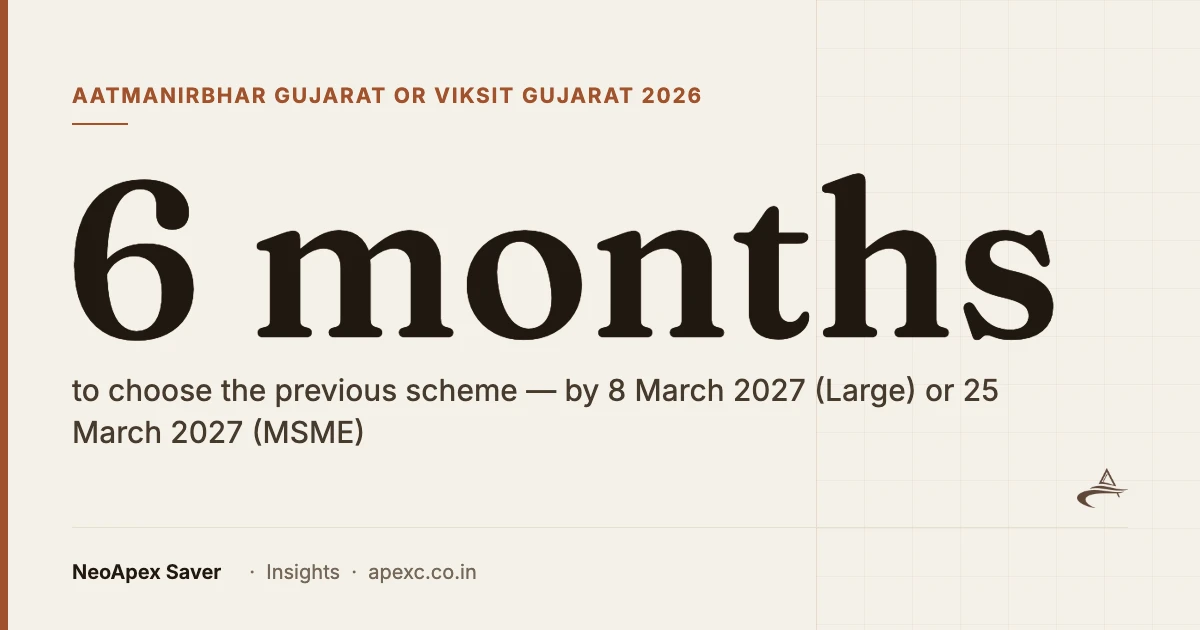
If your unit had not started commercial production before 1 June 2026, you can still choose the Aatmanirbhar Gujarat Scheme of 2022 instead of the Viksit Gujarat Industrial Policy 2026 — but only by exercising the option within six months of the relevant GR: 8 March 2027 for Large, Mega and Ultra Mega units, 25 March 2027 for MSMEs — and only if production starts by 4 October 2027. The choice is final. After the window, VGIP 2026 applies to everyone.
Three situations, three answers
Both scheme GRs — para 4.1 of the MSME GR and para 4A of the Large GR — draw the same three lines:
In production before 1 June 2026
You are on the previous scheme and stay there. The GRs say such enterprises “shall not be entitled to opt for benefits under this Scheme”. File your Aatmanirbhar claims as before; nothing in VGIP 2026 is open to you.
Not yet in production on 1 June 2026
You may apply under either scheme. To take the old one you must say so, in your application, within six months of the GR — and then start commercial production on or before 4 October 2027. Miss either date and the old scheme is gone.
Applying after the window
Every application received after the six months is considered only under VGIP 2026. Investment is counted from 1 January 2026, so money spent in the first five months of 2026 is not lost — it simply falls under the new rules.
Option deadlines by unit class
Swipe sideways to see every column
| Unit class | Governing GR | Exercise the option by | Old-scheme production deadline | After the window |
|---|---|---|---|---|
| MSMEs (plant & machinery up to ₹125 crore) | IMD/WRT/e-file/9/2026/2630/CH · 25.09.2026 | 25 March 2027 | 4 October 2027 | VGIP 2026 only |
| Large, Mega, Ultra Mega | IMD/WRT/e-file/9/2026/2320/I · 08.09.2026 | 8 March 2027 | 4 October 2027 | VGIP 2026 only |
The six months run from the date of issue of each GR, so the two classes have different deadlines. 4 October 2027 is the end of the Aatmanirbhar operative period (5 October 2022 to 4 October 2027); the GRs make it the outer limit for starting production under the old scheme.
A unit can change class between the two schemes. The MSME ceiling rose from ₹50 crore to ₹125 crore of plant & machinery. A ₹90 crore project was “Large” under the 2022 schemes and is an MSME under VGIP 2026 — so it compares the old Large package with the new MSME package, not like with like.
Aatmanirbhar Gujarat Scheme vs VGIP 2026, for an MSME
For MSMEs the new scheme pays capital subsidy to every size class as a percentage of EFCI (25% or 35%), a flat 7% interest subsidy and a per-unit power tariff subsidy, inside a combined ceiling of 35% or 45%. The old scheme paid capital subsidy only to micro units, interest subsidy of 5–7% with rupee caps, and reimbursed net SGST for up to ten years. Which is larger depends on your taluka, loan, power bill and how much SGST you actually pay in cash.
Swipe sideways to see every column
| Benefit | Aatmanirbhar Gujarat (2022) | VGIP 2026 |
|---|---|---|
| Capital subsidy | Micro enterprises only: 10–25% of the term loan, up to ₹10–35 lakh by taluka category | Micro, small and medium: 25% (Category B) or 35% (Category A) of EFCI; 30–35% in the five selected thrust sectors |
| Interest subsidy | 7%, 6% or 5% by taluka, up to ₹25–35 lakh a year, for 5–7 years | 7% in every taluka (8% for women entrepreneurs, manufacturing start-ups and first-generation entrepreneurs), 5 years, up to 10% of EFCI (20% in selected thrust sectors) |
| Power tariff subsidy | Not a component | ₹2 (A) or ₹1 (B) per unit for 5 years, up to 25% of EFCI (20% in selected thrust sectors) |
| Net SGST reimbursement | Yes — reimbursement of net SGST paid, for up to 10 years, within ceilings tied to EFCI | None |
| Combined ceiling | Per component | 45% (A) or 35% (B) of EFCI over 5 years; annual ceilings apply |
| Taluka categories | Three (I, II, III) | Two (A, B) |
| EPF, electricity duty | Available under the respective schemes | EPF 100% for 5 years, electricity duty exemption — both outside the ceiling |
For Large units the contrast is sharper: the 2022 Large and thrust-sector scheme was built around net SGST reimbursement, while VGIP 2026 pays capital, interest and power tariff subsidy inside a 15–40% ceiling with no SGST component. See the Large, Mega and Ultra Mega tables in our policy guide.
Five numbers that settle it
We model both schemes for every client inside the window. These are the inputs that move the answer — the first two most of all:
How much net SGST you will actually pay
The old scheme reimburses SGST paid in cash on your output. Exporters, units selling mostly to other states (IGST) and units with heavy input credit pay little net SGST — for them the old scheme’s headline benefit is small on the ground. Units with large domestic B2C sales in Gujarat pay the most and gain the most.
Ask your CA for net SGST paid per month on a comparable unitYour taluka — under both lists
The 2020 list had three categories; the 2026 list has two. A taluka that was Category II or III may now be Category B with a 35% ceiling — or Category A with 45%. Check both before you compare, and use the 2026 list for the new scheme.
Category A talukas earn the higher VGIP ratesLoan size against EFCI
VGIP 2026 interest subsidy is capped at 10% of EFCI (20% in selected thrust sectors) over five years; the old scheme capped it in rupees per year. A heavily leveraged small project and a lightly leveraged large one land on different sides.
The unit always bears at least 2% under either schemePower consumption
Only VGIP 2026 has a per-unit power tariff subsidy: ₹1 or ₹2 per unit for five years, up to 25% of EFCI. For foundries, ceramics, textiles processing and other energy-intensive plants it can be the largest single component.
Captive power does not count; DISCOM and open-access renewable supply doMicro status and timing
A micro enterprise receives its whole VGIP 2026 capital subsidy in year one; small and medium units over five years within annual ceilings. If cash in the first year matters, that weighs for the new scheme.
Status is decided on the date of project completion
Illustration, not advice. A ₹10 crore EFCI general-sector MSME in a Category B taluka, with a ₹6 crore term loan at 9.5% and a ₹40 lakh annual power bill, has a VGIP 2026 ceiling of ₹3.5 crore over five years; capital subsidy alone is ₹2.5 crore. Whether the old scheme beats that depends almost entirely on how much net SGST the unit would pay in ten years. We run both numbers before you sign anything.
What “exercising the option” means in practice
- Say it in the application. The GRs require the enterprise to “submit its application and exercise its option” for the previous scheme within six months of the GR. In practice that is the registration or eligibility-certificate application to the MSME Commissionerate or District Industries Centre (MSMEs) or the Industries Commissionerate (Large and above), with the option stated in writing.
- Keep the production date in view. The old scheme is available only if commercial production begins on or before 4 October 2027. If your project could slip past that date, the option is a bet you may not be able to collect on.
- Treat it as irrevocable. No change of option is entertained afterwards. Get the comparison, the taluka category and the sector tier confirmed in writing first.
- Watch the other clocks. Choosing VGIP 2026 does not pause its own deadlines: Large units must register by 8 December 2026 or before production, and MSMEs must apply for the eligibility certificate within six months of production. The Large-unit registration deadline, explained.
Option window: frequently asked questions
Who can still choose the Aatmanirbhar Gujarat Scheme?
Only an enterprise that had not started commercial production before 1 June 2026. It must exercise the option within six months of the relevant Government Resolution — by 8 March 2027 for Large, Mega and Ultra Mega units (GR dated 8 September 2026) and by 25 March 2027 for MSMEs (GR dated 25 September 2026) — and must start commercial production on or before 4 October 2027.
My unit started production in May 2026. Which scheme applies?
The previous scheme. Both GRs say an enterprise that commenced commercial production before 1 June 2026 is governed exclusively by the previous scheme and cannot opt into VGIP 2026.
What happens if I do nothing?
Once the six-month window closes, every application is considered only under VGIP 2026, with investment counted from 1 January 2026. Doing nothing is choosing the new scheme — which is the right answer for many units, but it should be a calculation, not an accident.
Can the option be changed later?
No. Both GRs state that the option, once exercised, is final and irrevocable and that no request for a change of option will be entertained.
Does the old scheme still pay SGST reimbursement?
The Aatmanirbhar Gujarat Schemes of 2022 reimburse net SGST paid for up to ten years, within ceilings tied to eligible fixed capital investment; VGIP 2026 has no SGST component at all. For a unit with large domestic B2C sales and little loan or power cost, that difference can decide the choice.
Still inside the window? Get both numbers before you choose
Send us your taluka, investment, loan plan, power load and a rough SGST profile. We model the Aatmanirbhar and VGIP 2026 packages side by side and confirm the deadlines that apply to your unit.

Written by the NeoApex Saver advisory team · Reviewed by Ashish Shah, Founder & Managing DirectorNeoApex Saver Pvt Ltd (formerly Apex Consultants) has filed Gujarat industrial incentive claims for over twenty years — 300+ projects, 99% filing success. Every figure in this article is taken from the Government Resolution linked above; worked examples and the reading of grey areas are ours.Last reviewed 7 October 2026 · About the team · Report a correction