

Reviewed by Ashish Shah, Managing Director7 October 20265 min readSource: MSME GR dated 25.09.2026
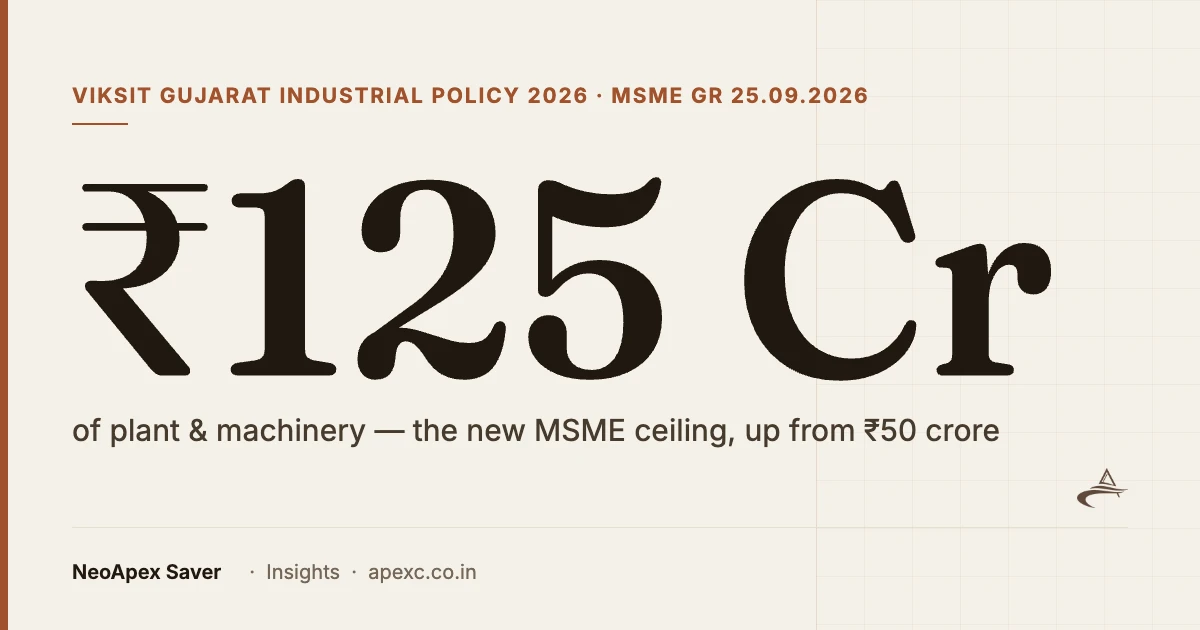
The VGIP 2026 MSME GR (No. IMD/WRT/e-file/9/2026/2630/CH dated 25 September 2026) defines MSMEs by gross fixed capital investment in plant and machinery across all units in the country: micro up to ₹2.5 crore, small up to ₹25 crore, medium up to ₹125 crore. The 2022 scheme stopped at ₹50 crore. The practical effect: a plant with ₹60 crore, ₹90 crore or ₹120 crore of machinery is now an MSME in Gujarat’s eyes, with a 35–45% combined ceiling instead of the 15–20% a general-sector Large unit gets.
Micro, small, medium and Large under VGIP 2026
Swipe sideways to see every column
| Class | Plant & machinery | Claims under | Combined ceiling, general sectors (A / B) |
|---|---|---|---|
| Micro | up to ₹2.5 crore | MSME GR · capital subsidy paid in year 1 | 45% / 35% |
| Small | above ₹2.5 crore, up to ₹25 crore | MSME GR · over 5 years | 45% / 35% |
| Medium | above ₹25 crore, up to ₹125 crore | MSME GR · over 5 years | 45% / 35% |
| Large | above ₹125 crore | Large GR · registration mandatory | 20% / 15% |
The investment counted is gross fixed capital investment in plant and machinery only — not land, building or working capital — summed across every unit the enterprise has anywhere in India. Status is decided on the date the project is completed (para 3.3).
From ₹50 crore to ₹125 crore
The Aatmanirbhar Gujarat Scheme for assistance to MSMEs (2022) applied up to ₹50 crore of plant and machinery; projects above that line fell under the Large and thrust-sector scheme, whose headline benefit was net SGST reimbursement. VGIP 2026 lifts the MSME line to ₹125 crore — in step with the Government of India’s revised MSME investment limits of ₹2.5, ₹25 and ₹125 crore in force since 1 April 2025 — but keeps a pure investment test, with no turnover limit.
Swipe sideways to see every column
| Aatmanirbhar Gujarat (2022) | VGIP 2026 | |
|---|---|---|
| Class | Large (above ₹50 crore) | Medium enterprise (up to ₹125 crore) |
| Capital subsidy | Not for Large units | 25% of EFCI35% in Category A |
| Interest subsidy | Per the Large scheme | 7% a year, 5 yearsup to 10% of EFCI |
| Power tariff subsidy | Not a component | ₹1 per unit, 5 yearsup to 25% of EFCI |
| Combined ceiling | Net-SGST based | 35% of EFCI over 5 yearsannual ceiling 7% |
| Registration | Large-unit registration | Udyam; PEC within 6 months of production |
The ceiling is the number to watch. For small and medium units the annual ceiling is 9% (A) or 7% (B) of EFCI, so a ₹90 crore EFCI unit in Category B can draw at most ₹6.3 crore a year across all three components, ₹31.5 crore over five years. Capital subsidy of 25% (₹22.5 crore) uses most of it; interest and power tariff subsidy fill the rest. Micro units get 27% or 37% in year one, then 2% a year.
Three things to check before you rely on MSME status
- All units, all of India. The ₹125 crore test is applied to plant and machinery across every unit of the enterprise, not the new project alone. A group company structure may change the answer.
- Completion, not sanction. Status is fixed at project completion. Cost overruns that push machinery past ₹125 crore move the project to the Large GR — which has its own mandatory registration, due before production or by 8 December 2026. Read the Large-unit deadline note.
- The investment window. MSMEs may continue investing for 12 months after the date of commercial production, or 18 months where plant and machinery exceeds ₹50 crore (para 3.2). Assets paid for outside the window drop out of EFCI.
MSME definition: frequently asked questions
What is the MSME definition under the Viksit Gujarat Industrial Policy 2026?
Para 1.2 of the MSME GR defines micro, small and medium enterprises by gross fixed capital investment in plant and machinery across all units in the country: micro up to ₹2.5 crore, small above ₹2.5 crore and up to ₹25 crore, medium above ₹25 crore and up to ₹125 crore. Above ₹125 crore a unit is Large and claims under the separate Large, Mega and Ultra Mega GR.
Does turnover matter for the Gujarat scheme?
No. The GR’s test is investment in plant and machinery alone. The Government of India’s MSME definition (revised from 1 April 2025) pairs the same investment limits with turnover limits of ₹10 crore, ₹100 crore and ₹500 crore, but the Gujarat GR does not import the turnover test.
When is MSME status decided?
On the date of completion of the project (para 3.3). A unit that is within ₹125 crore at the start but completes with more than ₹125 crore of plant and machinery is assessed as Large.
What changes for a ₹60–125 crore project?
Under the 2022 Aatmanirbhar Gujarat Scheme it was a Large unit; under VGIP 2026 it is an MSME, with capital subsidy of 25% or 35% of EFCI, interest subsidy up to 10% of EFCI and power tariff subsidy up to 25%, inside a 35–45% ceiling — against a 15–20% ceiling for a general-sector Large unit.
Do I need Udyam Registration?
The MSME GR accepts Udyam Registration, a Letter of Intent or Letter of Approval, an Industrial Entrepreneur Memorandum (or an amended IEM), an MCA21 filing or any other licence or permission notified by the Government of India as proof of a new enterprise. Udyam is the usual route.
Between ₹50 crore and ₹125 crore of machinery?
You are probably an MSME under VGIP 2026 — and the package is different from what the 2022 scheme offered. Send us your project cost and taluka and we will map the ceiling, the mix and the deadlines.
Written by the NeoApex Saver advisory team · Reviewed by Ashish Shah, Founder & Managing DirectorNeoApex Saver Pvt Ltd (formerly Apex Consultants) has filed Gujarat industrial incentive claims for over twenty years — 300+ projects, 99% filing success. Every figure in this article is taken from the Government Resolution linked above; worked examples and the reading of grey areas are ours.Last reviewed 7 October 2026 · About the team · Report a correction